Blog Post #13
Topic: Cancer Advances in Recent Years
While many of those, if not all, who teach at the university level will swear by the use of databases, in trying to do research about a relatively new program theres is no information about it in databases. Unfortunately, the cause that Dance Blue benefits, cancer, also only returns results in databases that are way over the head of any undergraduate. With this being said, I found an article in the INTECH database with an article about advances in cancer research.
The cure for cancer has been the holy grail of the medical field for decades. In the past four decades the death rates from cancer have been steadily declining, largely in part due to advances at the molecular level. Since scientists have been able to more closely study the human DNA, they have been able to sort out 680 different genes that can affect cancer treatment. This means that there is the possibility for more individualized treatments that result in less strain on the patient.
I will admit that this article is over the head of anyone besides a doctor, but it shows that advancements are being made in cancer treatments and finding a cure. However, much of this research isn't just theoretical, it requires very expensive equipment and highly paid technicians to do. This is where Dance Blue comes into play. The money raised from Dance Blue goes towards this cause. A good question for the Dance Blue committee would be to find out where the money actually ends up going, as in what group is the check given to.
By just skimming this lengthy article I've realized just how complex of an issue cancer is. This makes what Dance Blue does even more important.
--Stephen Ritchie
Reference:
Gabriela Mustata Wilson and Yagmur Muftuoglu (2012). Computational Strategies in Cancer Drug Discovery, Advances in Cancer Management, Prof. Ravinder Mohan (Ed.), ISBN: 978-953-307-870-0, InTech, DOI: 10.5772/24177. Available from: http://www.intechopen.com/books/advances-in-cancer-management/computational-strategies-in-cancer-drug-discovery
Thursday, October 9, 2014

Thursday, October 2, 2014
Dance Blue-- Reaching For The Stars
Blog Post #12
Topic: Dance Blue raises over $1.4 million for cancer research
An article written by Kentucky Sports Radio brings attention to the truly staggering amount of money that Dance Blue raised in 2014. From its humble roots in 2006 to now, the organization has truly been able to make a difference in cancer research and helping those with cancer and their families. --http://kentuckysportsradio.com/main/uk-dance-blue-raises-over-1-4-million-dollars-for-cancer-research/--
To be exact, in 2014 Dance Blue raised $1,436,606.24. This is an unfathomable amount of money, the bulk of it coming from broke Kentucky students. This just goes to show how much people care about Dance Blue and what it does for people. Even Kentucky basketball's own Coach Cal stopped in during the marathon to see how it was going, which just excites the participants even more.
What's interesting to me is questioning exactly why Dance Blue is so popular. Sure, raising money for cancer is a great thing, but that can be a one time cut check. What is it about Dance Blue that makes college students want to come? Being a freshman myself, I already know how all too valuable sleep is, so the fact that students are willing the stay up straight for 24 hours on a weekend is truly amazing.
By doing this research for Dance Blue, it makes me even more excited to participate this year. I would like to see what exactly happens at Dance Blue that makes it so memorable for students and drives them to do it year after year, and raise more and more money.
--Stephen Ritchie
Dance Blue-- A Mini Visual
Blog Post #11
Topic: Dance Blue Mini Marathon (2014)
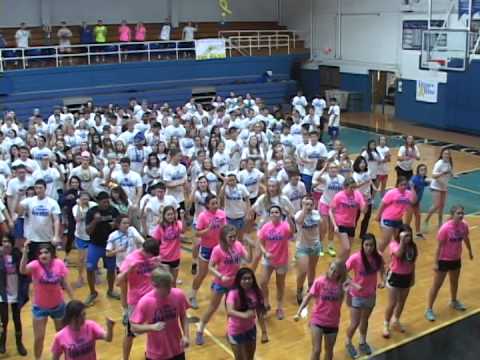
The above photo was taken at Lexington Catholic High School during their Dance Blue mini marathon last year. The photo was taken from a wn.com news article about the event. During the 2014 Dance Blue marathon, Lexington Catholic raised over $60,000 for the Dance Blue fund at the University of Kentucky.
Unfortunately you cannot see me in this picture. I attended the 2014 Dance Blue Mini Marathon, however, I was farther to the left than the angel of the camera. But trust me I was there and I had a great time. Not only did it get me service hours to complete my high school requirement, but I found myself having more fun than expected participating in all the events. During a mini-marathon a dance is taught to all the participants that incorporates multiple popular songs from that year. This dance is performed every hour on the hour during the duration of the 5 hours of the marathon. In between dances, participants can play games, eat food, make crafts, or just hang out, but like those at the University marathon they cannot sit down or sleep.
While the mini-marathon is a great event at Lexington Catholic High School, a good question that warrants further research is if other high schools or middle schools also participate in mini-marathons as well.
As mentioned before, I had a great time at Dance Blue, so I believe that more high schools should do it. This way when students get to the University of Kentucky they are already eager to participate in the 24-hour marathon.
--Stephen Ritchie
Dance Blue-- A Visual

Blog Post #10
Topic: Dance Blue Photo (2009)
The above picture is a photo that was taken at the end of the Dance Blue marathon in 2009. It shows that the students raised over $600,00 that year. This picture from the University of Kentucky Spotlight Archives does a good job of illustrating just how much fun students have at Dance Blue and how much good it does.
From the picture it's clearly apparent just how many people participate in Dance Blue, so many that in years past they have had to turn people away because the capacity of Memorial Coliseum is not enough to hold everyone. In the photo you can also see that there are many smaller groups of people that have different colored shirts on. These are different Dance Blue teams. For example, this year there is an Engineering team for Dance Blue that residents of Champion Court I who are in the Engineering Residential College can join. As a team you raise money together, create a team t-shirt, and participate in activities at Dance Blue together against other teams.
Some questions that come to mind with the amount of people in this photo is whether or not the Dance Blue has plans to change venues to be able to hold more people. I would think that Rupp Arena would be the largest indoor venue in Lexington, so maybe one day it will be held there, which would be cool. Also, it would be good to know if signups are on a first come first serve basis, or if certain team have precedence over others.
This should be a very exciting documentary to make. Unfortunately Dance Blue is not actually until February, so we will not be able to get video from this year's marathon, but there is still plenty of resources to explore to make our documentary.
--Stephen Ritchie
Thursday, September 25, 2014
Dance Blue--At The High School Level
Blog Post #9
Topic-The Dance Blue marathon at Lexington Catholic High School
While Dance Blue is based at the University of Kentucky, satellite mini-marathons have been started at surrounding high schools, one of these happens to be Lexington Catholic High School and my alma mater. All the information for this post comes from a primary source and that source is me. While at Lexington Catholic I attended two Dance Blue mini-marathons and enjoyed every minute of it.
Dance Blue mini-marathons are official Dance Blue marathons put on by the high school and are only 5-6 hours instead of the full 24 hours. However, all the same things are done, there is a dance that is learned and performed every hour on the hour, there's free food, and theres' activities to do such as volleyball or cornhole. At the end, usually about 11 o'clock, there is a big reveal for how much the marathon raised. Last year at Lexington Catholic we raised a little over $60,000. This is done through outside donations and every student who participates makes a $50 donation.
When I did Dance Blue I had an absolute blast, and I believe it's a good thing to be doing mini-marathons at the high school level. If I never seen what Dance Blue is all about, to be honest I would be leery of basically spending an entire weekend participating and then trying to recover. Personally I have never stayed up for 24 straight hours and that is an intimidating thing to do. This is why awareness of the event needs to be more readily available in the form of a documentary.
--Stephen Ritchie
Dance Blue--Origins
Blog Post #8
Topic: A brief history of how Dance Blue was started
Dance Blue is a charity event put on at the University of Kentucky to raise money for cancer research. To find information on how Dance Blue was originally created and what exactly it is I went to the most primary source I could find, the About section of the official Dance Blue website.
-http://danceblue.org/history/--
The Dance Blue Dance Marathon can trace its roots all the way back to Jarret Mynear. Jarret was a normal kid who just liked helping people. He had great success in conducting public speeches and throwing philanthropy events including founding Jarret's Joy Cart. The biggest obstacle in Jarret's life however was cancer. By the time he was only six years old he had already been diagnosed with and battled 6 different cancers. In 2002, during one of his last weeks he made a list of things he wanted done. One thing he wanted done was to figure out a way to raise more money for the Pediatric Oncology Outpatient Clinic at Kentucky Children’s Hospital. After his passing the fund, the Jarret Myear Fund raised money to help improve the physical center, however, it was noticed that the emotional needs of cancer patients and their families were neglected. This led to the creation of the Golden Matrix Fund. Jennifer Myear, Jarret's mother, then went on to figure out how to get University of Kentucky Students involved and this led to the creation of Dance Blue, a 24-hour dance marathon where students stay awake and on their feet for 24 hours and make donations to the fund. In 2014 Dance Blue alone raised over $1 million.
Dance Blue is a constantly evolving event and this makes it a perfect thing to research. Raising awareness for cancer research is always a good thing, and the Myears along with the University of Kentucky have found a fun way to do that so this would be a great topic to research.
--Stephen Ritchie
Shark Tank...A Retrospect
Blog Post #7
Topic: Reflection on Shark Tank Formal Proposal
When I first heard that I was going to have to be giving a "shark tank" speech in class I was honestly not too happy. I have never been a huge fan on public speaking, however, looking back on the presentation I'm very glad I went through it.
The writing process I used for this proposal was the same as I have used for any other paper...I say I'm going to write out an outline, work on it little by little, and make a really good paper. In reality, I ended up writing the entire paper on two occasions without an outline. I believe it is a good thing that we had done blog posts on the subject because they acted as an impromptu kind of outline and it gave me a good place to start.
For my presentation, the written proposal helped in giving my speech direction. I'm actually surprised how little I actually could actually say in a 2-4 minute speech while maintaing a normal speaking rate. This made me have to think what were not only the most important points to say, but what points would stand out to the audience since they had to listen to multiple presentations in one class period.
In my written proposal I believe my strength was that I gave a good ratio of background information to persuasive statements. I would go on to say that a weakness in my paper would be that some sentences seemed to go on for too long, or were difficult to read. For my proposal my strength was that I knew what I was going to say and did my best to not have any dull or awkward moments/pauses. Because of this, a weakness that could get me in trouble is if I lost my train of thought, or forgot a notecard, I could have trouble getting through the presentation.
--Stephen Ritchie
Subscribe to:
Posts (Atom)